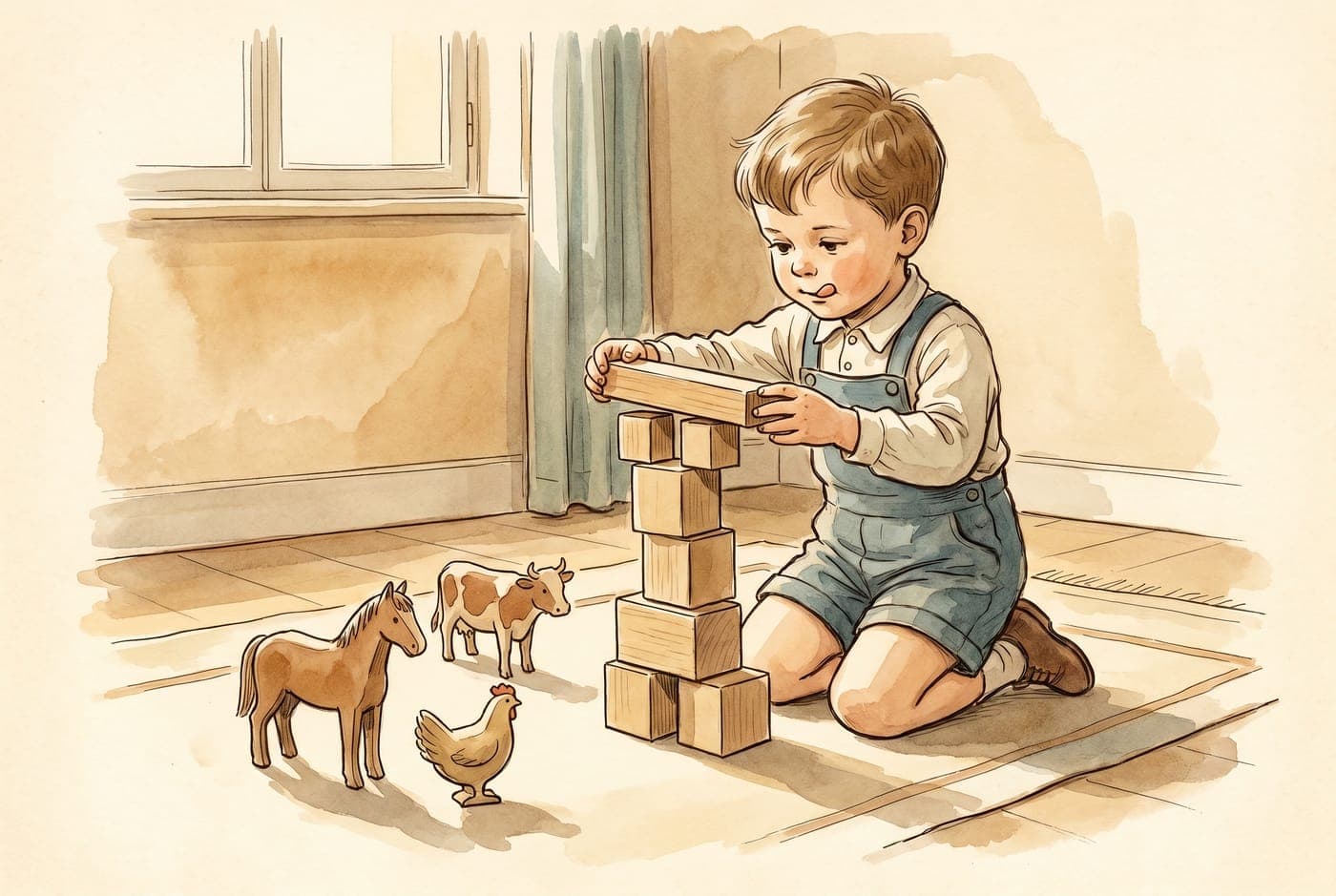
Blocks don't blink, sing, or vibrate. They just sit there. And yet, hour for hour, they may be the strongest toy in your house for early math, language, and engineering brain wiring. Here's how to make them work harder for you.
What a tower is actually teaching
A block is a math problem you can hold
Stack two blocks. They balance. Stack four. They wobble. Try to put a long block on top of a tiny one. The whole thing crashes. Your child has just experienced gravity, base, ratio, and balance in a few seconds, without anyone teaching anything.
That hands-on intuition is what later sits underneath geometry, fractions, and physics. The kid who has built a thousand small towers shows up to math class already knowing how shapes fit together, even if they can't name a single theorem.
Blocks pull rich language out of adults
Sit a parent next to a child with a tablet and you'll hear: "mm-hm" and "careful." Sit the same parent next to the same child with blocks and you get: "put the long one on top of the short one," "that one's wider," "turn it sideways," "under the bridge."