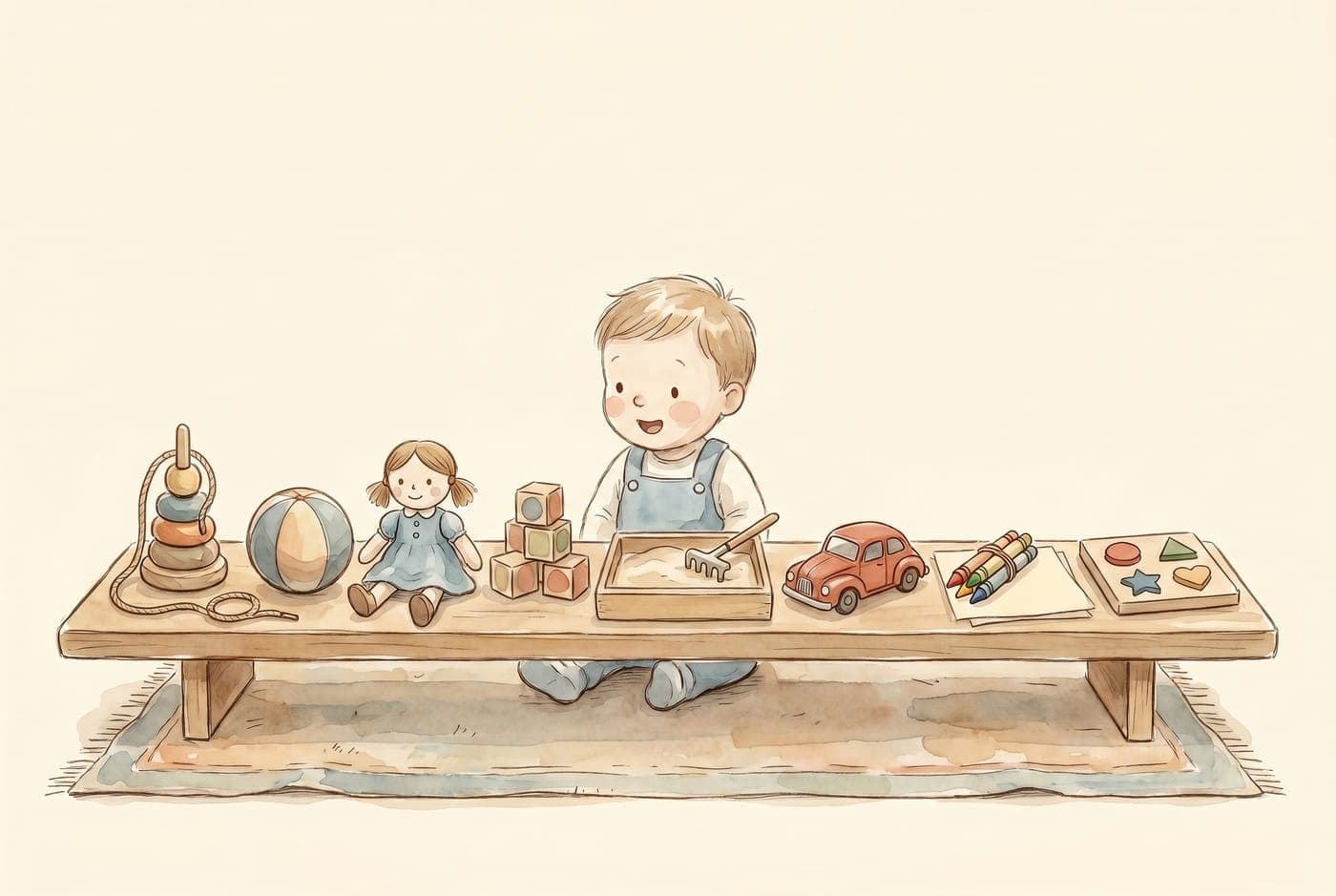
Children develop through 8 types of play: fine motor, gross motor, imaginative, construction, sensory, vehicles, creative, and learning. Most toyboxes only exercise 2 or 3.
Why most toyboxes fail your child's development
The favorite-toy trap
Your two-year-old asks for cars. So you buy more cars. Different colors, different brands, bigger, smaller. It looks like variety. But to their developing brain, it's the same skill loop on repeat: push, roll, crash, repeat. Meanwhile the play dough dries out in the closet, the beads stay in their bag, and the dress-up bin collects dust, not because your child wouldn't love them, but because they never get a turn. Child development research organizes play into 8 distinct categories, each one building different skills. Five different sets of trains still exercise the same part of your child's brain, but one train, one set of beads, one play kitchen, and one ball build four different pathways at once: spatial navigation, fine motor control, social-emotional development, and gross motor coordination. When children are regularly exposed to all 8 categories, they develop more evenly and play more creatively. When 5 or 6 are missing from their daily environment, those skills don't develop on their own.
Small gaps now, big delays later
A toddler who rarely touches sensory materials doesn't just miss out on a fun afternoon - they get less practice with self-regulation, texture processing, and emotional grounding. A child who never does imaginative play builds weaker empathy and language circuits.
These aren't dramatic, overnight problems. They're quiet, compounding gaps that show up months or even years later as difficulty focusing, trouble with transitions, or delayed language. The fix is surprisingly simple: make sure the right toys are actually in front of them on a regular basis.
What balanced play actually looks like
How Toy Rotation App helps
1. Scan your toys. All of them.
Point your phone at any toy. AI identifies it and categorizes it across the 8 developmental dimensions. Kitchen set? Imaginative play. Wooden beads? Fine motor. That random ball under the couch? Gross motor.
Scan all toys in minutes. For the first time, you can see your entire toy collection organized not by room or bin, but by what each toy actually does for your child.
2. See your blind spots
Your catalog shows every toy grouped by developmental category. The insight is instant: 14 vehicles, 9 construction sets, 1 sensory toy, 0 creative. You can finally see where your child is getting lots of repetition and where key kinds of play barely show up at all.
Toy Rotation App surfaces toys you forgot you had. The threading beads from last Christmas. The watercolor set still in the packaging. Often the answer isn't buying more toys. It's realizing the right toys are already in your house.
3. Get the right toys out next
Instead of pulling random toys off a shelf, Toy Rotation App builds a ready-to-use rotation from across your available categories. One fine motor toy, one gross motor, one imaginative, one sensory, and the exact toys change, but the balance stays.
Research shows toddlers given fewer, well-chosen toys play twice as long and more creatively. You keep 6-10 toys out, store the rest, and swap every 1-4 weeks. Old toys feel brand new. The app tells you what to put out so you don't have to build the rotation yourself.
4. Play ideas that connect the toys
Each rotation comes with guided play stories built around the specific toys that are out. Not generic activities but invitations tailored to your child's exact toys and age.
Research on guided play shows children explore more deeply when given a narrative frame: not instructions, not total free play, but a gentle story that sparks their own ideas. That's what Toy Rotation App generates for every rotation.
Questions parents ask
What if almost all our toys are in one category?
That's totally normal and exactly what Toy Rotation App helps with. You probably have more variety than you think buried in closets and bins. Scanning surfaces it. And when you do see a real gap, you'll know exactly which type to look for next.
Do I need to buy new toys to cover all 8?
Nope. Most families already own more than they realize. The play dough in the back of the pantry? Sensory. That old xylophone? Creative. Toy Rotation App just makes sure those toys actually get played with.
How does the AI know which category a toy belongs to?
You snap a photo. AI identifies the toy and maps it to one of 8 developmental categories. You can always override it if you disagree.
How many toys should be out at once?
Research points to 8-10 as the sweet spot. Enough to explore, few enough to actually focus. Toy Rotation App recommends a count based on your child's age, and you can adjust it any time.
Where's my data stored?
On your device. Toy inventory, rotations, play stories: all local. We only need the internet when scanning new toys or generating rotations. See our Privacy Policy.