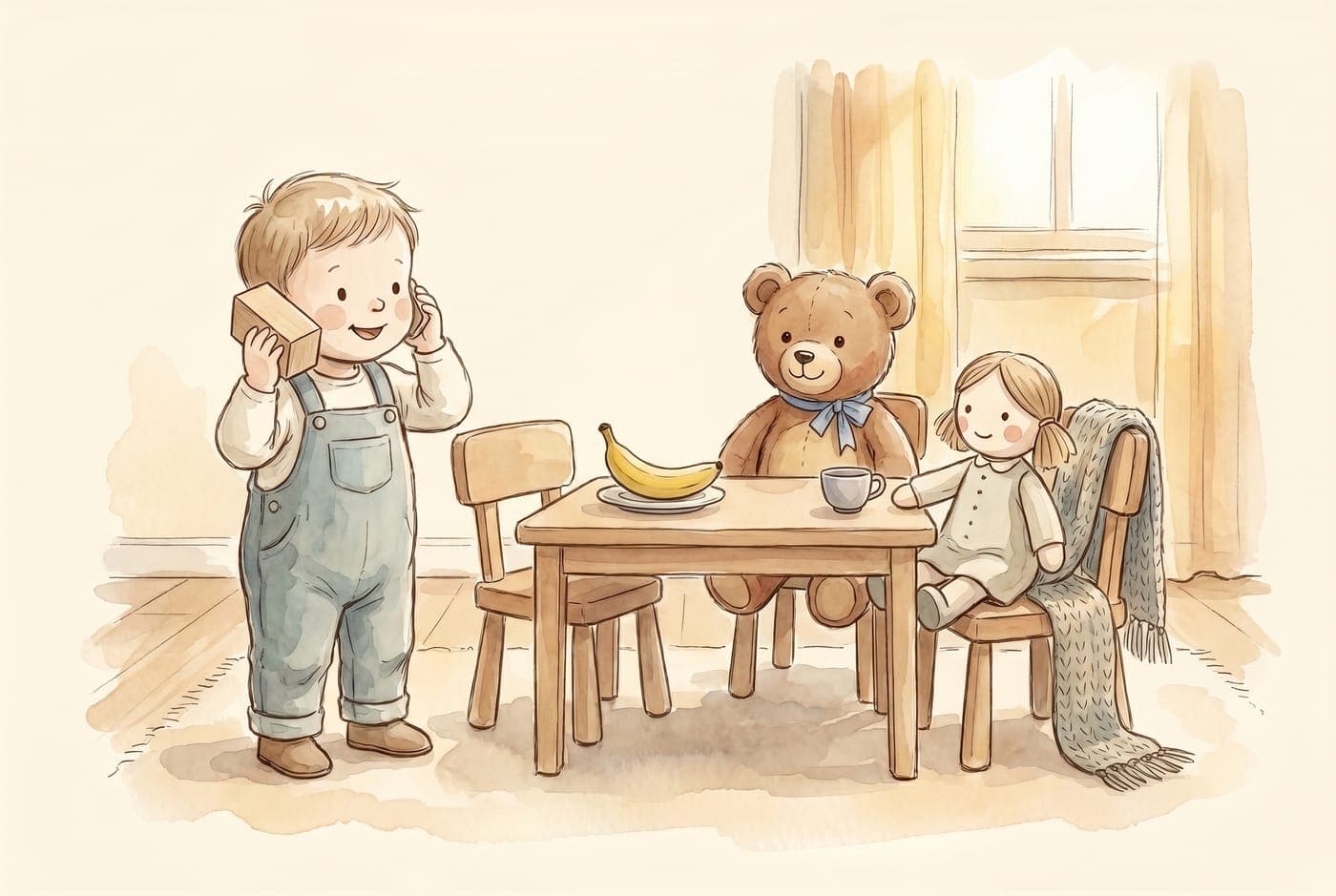
Your toddler hands you a wooden block and says "here's your coffee." You sip the block. That tiny moment is one of the busiest things their brain does all day. Here's what's really happening under the hood, and how to keep feeding it.
One block, two minds, a thousand connections
A block becomes a phone. Here's what just happened.
To turn a block into a phone, your child has to hold two ideas at once. This is a block. This is also, right now, a phone. They have to remember the rule we just made up. They have to ignore the fact that the block doesn't ring. They have to act out the phone parts. Then, two minutes later, when you pretend to call them, they have to switch sides.
That juggling act is what brains call symbolic thinking. It's the same skill that later lets a child understand that the squiggle on a page stands for the sound "buh" which stands for the word "ball." Pretending is reading practice in disguise.
Pretend play is where feelings get rehearsed
When a child plays "the bear is sad," they are doing two things at once. They feel the sadness a little. They also stay outside it, steering the story. That gap, between feeling something and watching yourself feel it, is the skill we usually call self-control.