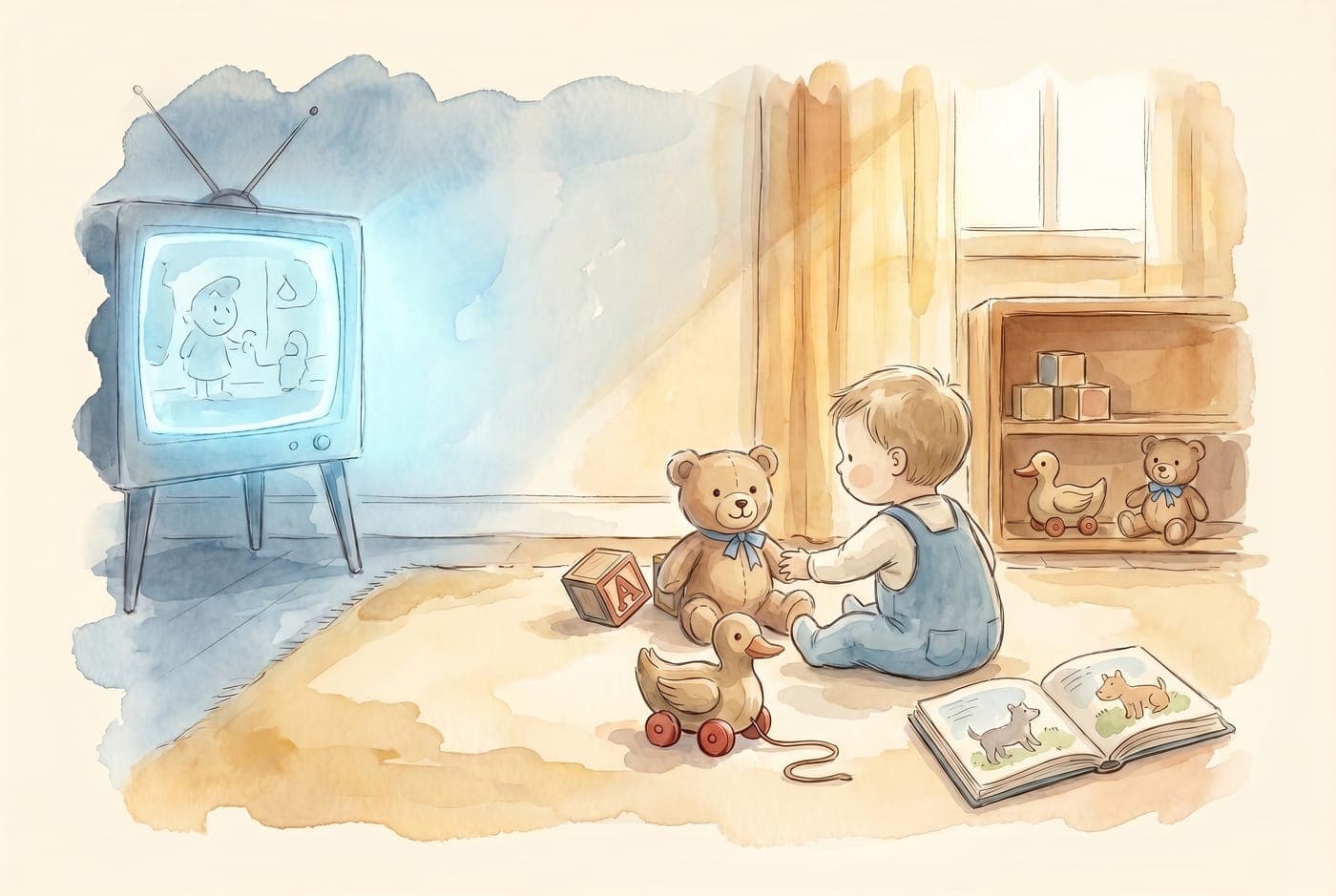
The cost of an hour of cartoons is not really the cartoons. It's the hour of pretend, peer time, and parent talk that didn't happen in its place. This is the part of the screen-time conversation that actually matters at home.
It's not the show. It's the hour the show ate.
Screens crowd out peer play, not reading
Most families assume the harm of screens is on the screen. The bigger pattern is quieter than that. When screen time goes up, the thing that shrinks is unstructured play with other kids. Reading aloud, the holy grail of language development, mostly survives. Wrestling on the rug with a cousin, building a fort, chasing each other in circles in the yard, that's what quietly disappears.
And that kind of play happens to be exactly where social skills, problem-solving, and negotiation get rehearsed.
Electronic toys are quieter screens
Battery-powered toys that talk, sing, and light up sit in the same family as screens. They do a lot of the "playing" for the child. Parents naturally say less around them, because the toy is already saying everything. Wooden puzzles, fabric balls, simple blocks, on the other hand, leave so much room that the room fills up with adult words.
If you're trying to cut screens, look at the talking toys too. They're the second draft of the same problem.
More screen time tracks with delayed talking and problem solving
Kids who get a lot of screen time as toddlers tend to show up later, on average, with weaker communication and problem-solving skills. Not every kid. Not catastrophically. But it's a consistent direction. The more screen, the more drag on the parts of development that depend on back-and-forth with a real person.
Motor skills and physical development tend to be less affected. The damage clusters around the social and verbal parts of the brain.
Six small moves that actually cut screen time
1. Make the alternative visible before the meltdown
Screens win when nothing else is in sight. The moment your kid is bored, hungry, or tired, an invisible bin of toys may as well not exist. Set out a small basket of 5 to 8 toys in the morning, somewhere they walk past. That quiet pre-staging is doing 80% of the work.
2. Set a default, not a rule
Rules invite negotiation. Defaults don't. "In our house, we don't do shows before dinner" is much easier than issuing a verdict every afternoon. Kids stop asking after a week or two because the answer never moves.
You can have generous defaults. You just have to actually have them, and have them be predictable.
3. Make screens a place, not a portable thing
Tablets in the bedroom, in the car, in the stroller, at restaurants, that's the version that quietly takes over a childhood. Try anchoring screens to one room or one piece of furniture. Now "watching something" means sitting in that spot, not pulling reality out of every dull moment.
4. Watch with them when you can
Co-viewing changes screen time from passive receiving to a shared experience. You ask questions. They notice things. The show becomes a conversation. Even ten minutes of doing this once a week shifts the whole tone of how your kid relates to screens.
5. Stack toys near the couch
If the screen is in the living room, that's where the best alternative needs to live. A small basket of cars, blocks, animal figures, and a book or two within arm's reach of the couch will pull your kid in surprisingly often. The toy doesn't have to beat the screen. It just has to be closer than the remote.
6. Be honest about your own phone
Kids don't copy what you say about screens. They copy what you do with yours. If your phone is in your hand from the moment you sit on the floor, they'll learn that the floor and a screen go together. The single biggest screen-time intervention is often a parent putting their phone in another room for thirty minutes.
Questions parents ask
How much screen time is okay?
Most pediatric guidance for under-2s is to keep it close to zero outside of video calls. For 2 to 5, a common target is under one hour of high-quality content per day. The numbers matter less than the pattern: are screens filling the boring gaps, or used on purpose at set times?
What about "educational" apps?
A few are genuinely good. Most are average content with a marketing claim. Even the good ones are still doing the thing your child would learn faster from doing in real life with you. Treat "educational" the way you'd treat "low-fat" on a cookie package. Mildly true. Not the point.
We use screens to get dinner made. That's fine, right?
Yes, with a small caveat. Used as one tool among many, screens are fine. The thing to watch is whether it becomes the only tool. A rotating shelf of independent-play toys near the kitchen can buy you the same twenty minutes more often than you'd think.
My kid screams when I turn it off. Help.
That's normal and not a sign you've broken anything. Two things help: warn before turning off ("one more song, then off"), and have something specific ready to do next, not just a vague "go play." A pre-set basket of toys, or a job in the kitchen with you, lands better than open air.
Are some screens worse than others?
Yes. Short, fast-cut content (auto-played videos, very fast cartoons) seems harder on attention than long-form, slower content. Live video calls with people they love are basically fine. A movie watched together looks more like family time than screen time.