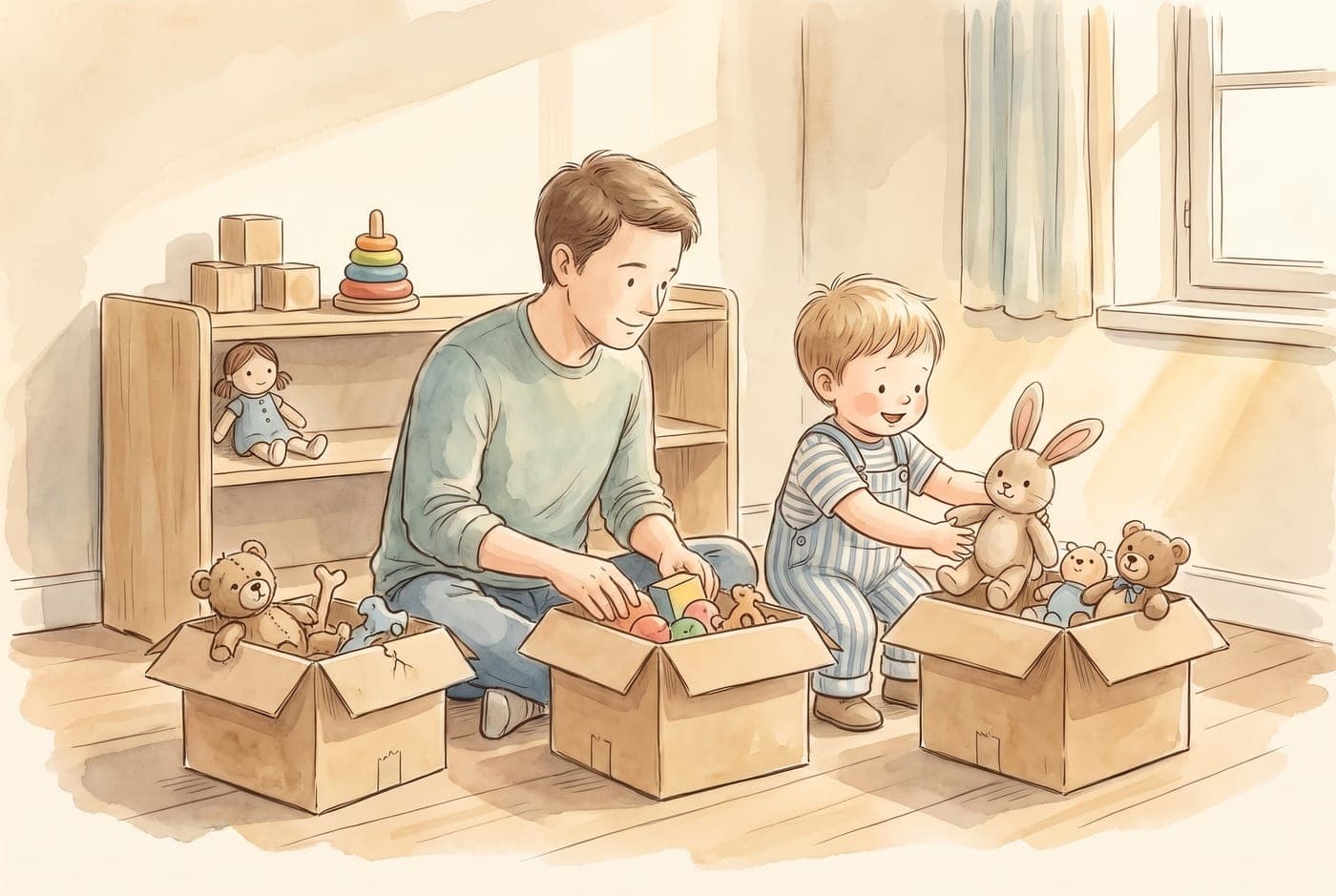
When you declutter toys, it usually goes wrong in one of two ways. Either you get rid of too much and your child spends a week asking for the dinosaur, or you keep everything "just in case" and the playroom is full again by spring.
The approach here sits in the middle: get rid of what is broken, outgrown, or unloved, and put most of what is left into storage for a toy rotation instead of giving it away. Your child loses very little, and the room gets a lot calmer.
How many toys does a child need?
There is no right number. How many toys are out at once makes more difference than the total. In a 2018 University of Toledo study, 36 toddlers each played once with 4 toys in the room and once with 16. With 4 toys, they played with each toy for longer and found more ways to use it (Dauch et al., Infant Behavior and Development).
So aim for a collection you can split into three or four rotations of about 6 to 10 toys each (fewer for babies). For most toddlers and preschoolers that is 20 to 40 toys, plus books, art supplies, and comfort objects. If you have far more than that, decluttering helps. If you have roughly that many and the house still feels overrun, the problem is how many are out, and a toy rotation system will fix it faster than giving toys away.
Before you start
Pick a time when your child is asleep or out, if they are under three or four. Toddlers find it very hard to decide what to give away, and watching their toys go into bags upsets many of them. Older children can help with part of it; see below.
Get three bags or boxes ready and label them: toss, donate, and keep. You will add a fourth pile, "rest," near the end.
Give yourself a time limit. One room in one or two hours is realistic. Doing the whole house in one go usually stalls halfway with every toy on the floor.
How to declutter toys, step by step
1. Gather everything in one place
Bring toys from every room into one pile. Seeing it all at once is often enough to make the decisions easier.
2. Toss what is broken
Anything cracked, missing key pieces, with sharp edges, or with electronics that no longer work goes in the toss bag. Puzzles missing more than a piece or two go too. Be strict here; a broken toy rarely gets fixed.
3. Pull out the outgrown
Toys your child has clearly moved past, like baby rattles for a 4-year-old, go in donate. If a younger sibling is coming, keep a small box of the best ones and donate the rest.
4. Find the duplicates
Group the toys by type. You will probably find five toy phones, three shape sorters, or twenty cars. Keep the best one or two of each and donate the others, unless your child plays with them as a set (the cars often count as one set).
5. Sort what's left into keep out, rest, or donate
For each toy left, ask whether your child has played with it in the last few months. A toy that hasn't been played with doesn't have to go. Toys that sit unused on a crowded shelf often get played with once they are one of eight on a clear shelf. Put those in a pile marked "rest" for your rotation, and only donate the ones you're sure about.
6. Box the "rest" pile for rotation
Pack the rest pile into three or four bins, one per rotation, and store them out of sight. Our guide to toy storage for small spaces covers where to put the bins. Toys that sit in rotation for a few months and still never get played with can be donated next time, with much more confidence.
How to involve kids
From around age 4, many children can take part, as long as you ask the right question. "Which toys do you want to give away?" tends to end in tears. "Which toys should stay out this week, and which should rest in the closet?" usually works, because nothing is gone forever.
For donating, give older children a smaller job: choose three toys to give to a younger child or a toy drive. Letting them pick and hand over the toys themselves makes giving them away a lot easier.
Gifts and sentimental toys
Toys from grandparents are the hardest part for many families. Rotation helps here: a gift doesn't have to stay out to be kept. When the giver visits, put it back on the shelf.
For sentimental toys, like a first teddy or a handmade blanket, keep a small memory box that sits outside the rotation. It doesn't count toward the total.
Keep it from filling up again
Use one in, one out for birthdays and holidays. When a new toy arrives, one goes into the donate bag or into storage.
Share a short list with relatives before gift seasons, built around what your rotations are missing. If you have no creative toys and fourteen vehicles, say so.
Declutter again twice a year, before birthdays and the winter holidays, when new toys are about to arrive anyway.
Questions parents ask
Will my child notice their toys are gone?
Usually much less than parents expect, especially if most toys went into storage instead of out of the house. If they ask for one, get it out; it is still in the closet.
Where to donate used toys
Charity shops, shelters, preschools, churches, and toy libraries often take clean used toys in good condition, but policies vary, so call ahead. Some won't take used stuffed animals. Children's hospitals and many holiday toy drives ask for new, unwrapped toys, so call first. Local parent groups are often the quickest option for toys in good shape.
Should I clean toys before donating or storing them?
Yes. Wipe hard plastic toys with warm soapy water, wash fabric toys if the label allows, and let everything dry fully before it goes into a closed bin, so nothing goes moldy in storage.
How often should I declutter toys?
Twice a year is enough for most families once a rotation is running. The rotation shows you which toys never get played with, so each declutter takes less time than the last.
Sources
- Dauch, C., Imwalle, M., Ocasio, B., & Metz, A. E. (2018). The influence of the number of toys in the environment on toddlers' play. Infant Behavior and Development, 50, 78-87.