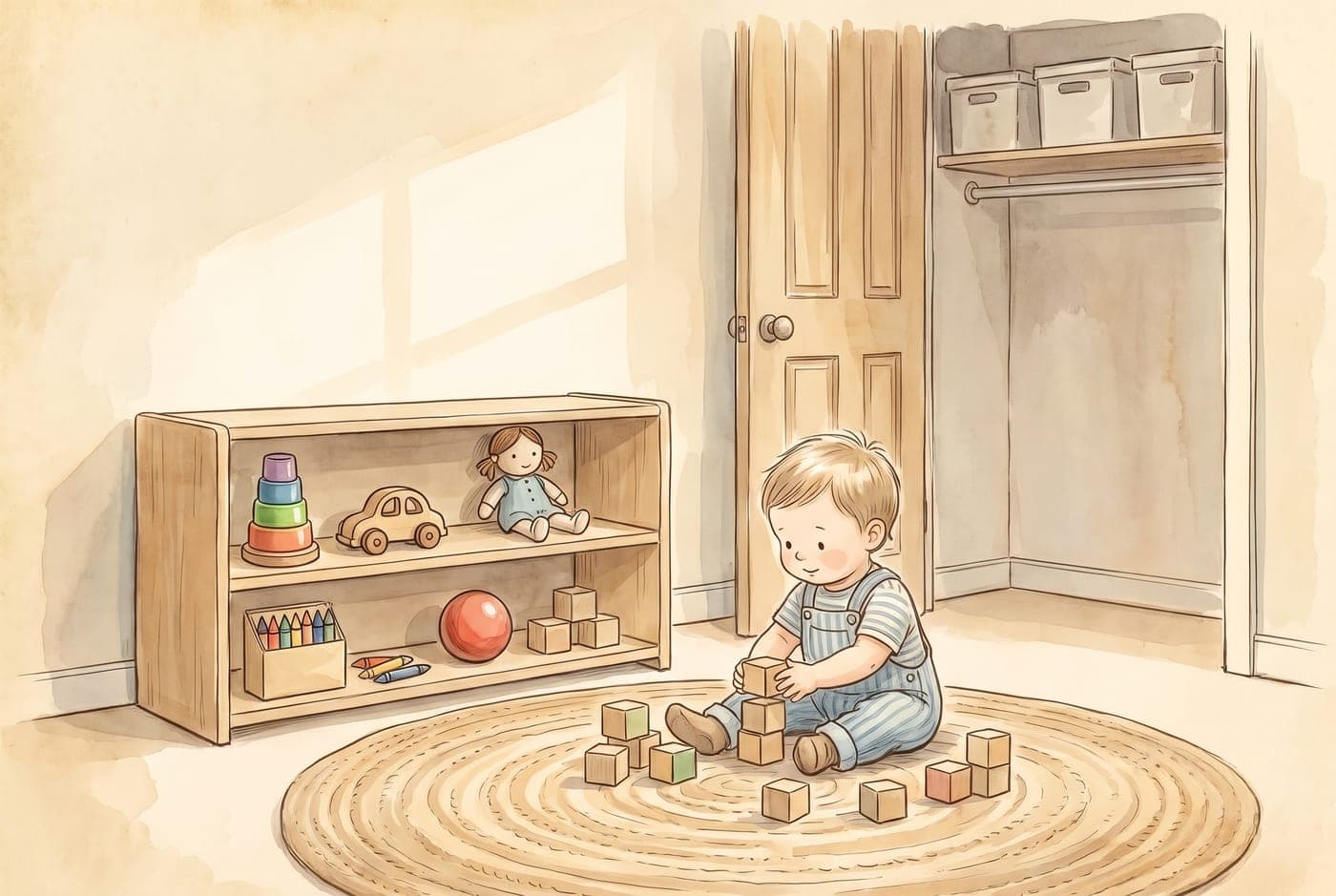
Most toy storage ideas for small spaces are about fitting more toys into the room: cube shelves, under-sofa drawers, baskets that hang off the back of a door. That helps for a month, and then the baskets are full too.
The bigger win in a small home is having fewer toys in the room at all. If only 6 to 10 toys are out, they fit on one shelf or in two baskets, and the rest can live packed tight somewhere your child never sees. This guide covers how to set that up in an apartment, a shared living room, or a kid's bedroom with no playroom.
Split storage into two zones
Think of your toys as living in two places.
The play zone is where your child plays: a corner of the living room, part of their bedroom, a rug in the kitchen. It holds only the toys in the current rotation, on low, open storage your child can reach and tidy themselves.
The resting zone is everything else. It can be dense, high up, or awkward to reach, because nobody needs to get to it more than once every couple of weeks. A closet top shelf, the space under a bed, or a bin in the hall cupboard all work.
The play zone stays small enough to tidy in five minutes, and the resting zone can be packed as tightly as you like, because nobody browses it.
Living room toy storage ideas
A living room play zone needs to look acceptable at 8pm and hold a rotation during the day.
- One low cube shelf or bookcase with 6 to 10 toys spaced out on it. Leave gaps between toys; a toddler can see and choose from a shelf in a way they can't from a full bin.
- Two or three lidded baskets for toys with lots of pieces, like blocks or play food. Lids mean the evening tidy-up is "put it in the basket" and the room looks done.
- A storage ottoman or bench for the current rotation's larger toys, which doubles as seating.
- A sideboard or TV cabinet with doors, if you want the play zone to disappear completely after bedtime.
Skip the big open toy box. Everything sinks to the bottom, your child dumps it to find one thing, and you're back to a floor covered in toys. If you do use a toy chest, choose one with no lid or a lid that stays open on its own, so it can't drop on small heads or fingers.
Hidden toy storage ideas for the rest
Hidden toy storage is where the resting toys go. The two rules are that your child shouldn't be able to see them, and you should be able to find a bin quickly when it is swap day.
- Use opaque bins. A toy your child can see through a clear bin is still "out" as far as their attention goes.
- Use one bin size. Same-size bins stack, slide under beds, and fit on one closet shelf.
- Label each bin with a number, and tape a list or a photo of the contents to the lid.
- Keep bins up high or behind a door. A closet top shelf, the back of a wardrobe, under the bed in shallow rolling boxes, or a high shelf in a utility room.
If you have no closet space at all, a tall cabinet with doors in a hallway can hold three or four bins. Anchor any tall shelf or cabinet to the wall; climbing toddlers can tip over furniture that looks stable.
Toy rotation storage: how many bins and how big
Three or four bins is enough for most families. Each bin holds one rotation, so the bins should be big enough for 6 to 10 toys and no bigger. A box of about 30 to 40 liters (8 to 10 gallons), the size of a shallow underbed box, fits a typical toddler rotation. You don't need to buy anything to start: diaper boxes or shoe boxes work fine for the first month, and you'll know by then what size you need.
Fill each bin with roughly one toy from each category, so every rotation has variety. Our toy rotation system guide covers the setup step by step, and toy rotation categories explains how to sort toys into categories.
Toys that don't fit in any bin, like a play kitchen or a ride-on, can stay out as furniture. Rotate the accessories instead: the pots and play food go into bins, and the kitchen gets a different set each time.
Storage ideas by room
Small bedroom
Use the bed as storage: rolling boxes underneath hold two rotation bins. A narrow shelf at your child's height holds the current set. Keep the bedroom rotation calmer, with books, puzzles, and soft toys, and leave the louder toys in the main play zone.
Shared living room
Keep the play zone in one corner on a rug, so the edges of the rug mark where toys live. Baskets with lids go against the wall. Anything noisy or large stays in the resting zone.
Apartment with no playroom
Pick one play zone and stick to it, even if it is a 5-foot strip of floor along a wall. Toys that are allowed everywhere end up everywhere. Store the resting bins in whatever closet has the most height.
Questions parents ask
How many toys should be in a small space?
Six to ten in the play zone is plenty for most toddlers and preschoolers, plus comfort toys and books. A 2018 University of Toledo study found toddlers played longer and more creatively with 4 toys in a room than with 16 (Dauch et al.).
Clear or opaque bins?
Opaque for resting toys. Clear bins are fine in the play zone for things like art supplies, where you want your child to see what is inside.
What should I do with toys that don't fit anywhere?
Then there are probably more toys than the space can hold, even with rotation. Our guide to decluttering toys covers how to cut down without upsetting your child.
Is it okay to store toys in the garage or basement?
Yes, if the space is dry. Use bins with tight lids to keep out dust and damp, and keep anything with fabric or batteries indoors if your garage gets very hot or cold.