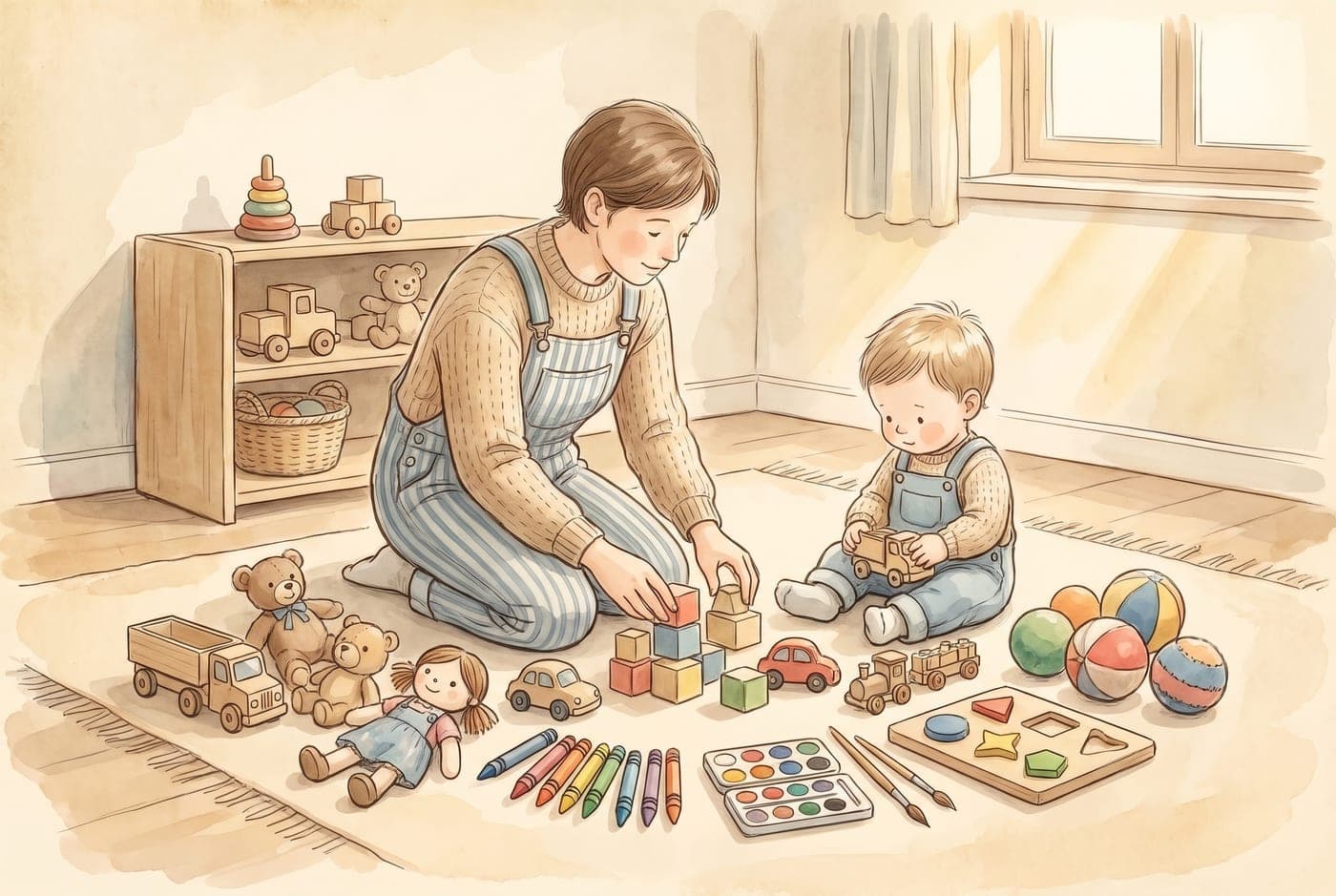
A toy rotation works best when each shelf has variety: something to build with, something to pretend with, something to move with, something to make with. Sorting toys into categories before you rotate is how you get that variety without thinking about it every swap. Put one toy from each category out, store the rest, and the shelf balances itself.
These are the eight categories Toy Rotation App uses. They group toys by the kind of play they invite, which is more useful than grouping by brand, material, or which room they came from.
The 8 toy rotation categories
Fine motor
Toys that use small hand movements: grasping, pinching, twisting, threading. Shape sorters, stacking rings, peg puzzles, lacing beads, lock boxes, and chunky knobbed puzzles all go here. For babies it might be a rattle with a handle; for a 4-year-old it is a bead kit or a set of tweezers and pom-poms.
Gross motor
Toys that get the whole body moving. Balls, push walkers, ride-ons, tunnels, balance boards, stepping stones, and a mini trampoline. Big toys like a climbing triangle can stay out all the time if you have the room; rotate the smaller ones around them.
Imaginative play
Anything your child uses to pretend: dolls, stuffed animals, play food, a toy kitchen's pots and pans, dress-up clothes, a doctor kit, animal figures, puppets. Stuffed animals live here unless one is a comfort object, in which case it never rotates.
Construction
Toys for building. Blocks, Duplo and Lego, magnetic tiles, train track, stacking cups, cardboard bricks. Building toys are some of the best to rotate back, because a child who could stack three blocks last month may stack six now.
Sensory
Toys that are mostly about touch, sound, or sight. Crinkle books, sensory bottles, textured balls, rain sticks, a rice or dried-pasta bin, kinetic sand, musical instruments. Musical toys can sit here or in creative; pick one and be consistent.
Vehicles
Cars, trucks, trains, planes, and boats. This category gets its own slot because many families own far more vehicles than anything else, often from gifts. Rotate two or three at a time and the rest feel new when they return.
Creative
Toys for making things. Crayons, paint, playdough, stickers, chalk, a craft basket, collage materials. Many families keep a small art basket out all the time and rotate the materials inside it.
Learning
Toys built around a concept: numbers, letters, colors, shapes, matching, cause and effect. Counting bears, memory games, alphabet puzzles, first board games, a toy cash register, a pop-up toy. If a toy teaches a concept and also involves building or pretending, it can go here or in that category; choose whichever way your child plays with it most.
How to use categories in a rotation
Sort every toy into one category. When a toy could fit two, pick the way your child uses it. A wooden train set is construction for a child who builds layouts and vehicles for one who just pushes the engine around.
Count each category. Most families find their toys are lopsided: twelve vehicles, nine construction sets, one sensory toy, nothing creative. You don't need to fix that by buying more. Your rotations will simply have two vehicles and no sensory toy until you add one, and that is fine.
Split each category across your bins. If you have four rotation bins and eight vehicles, put two vehicles in each bin. Our toy rotation system guide covers the bins and swap schedule.
Aim for one toy per category on each shelf, which gives a shelf of 6 to 8 toys. For babies, drop a few categories; for preschoolers, add a second toy in their favorite category.
Toy rotation categories by age: sample shelves
6 to 12 months
Babies need fewer toys out, so use four or five categories: fine motor (stacking rings), sensory (crinkle book or a rattle), gross motor (a soft ball to crawl after), learning (a pop-up or cause-and-effect toy), and imaginative (a soft doll or animal). Rotate weekly. Our guide to toys for 6 to 12 month olds lists what babies this age play with.
1 year olds
One-year-olds are walking, banging, and filling and dumping containers. A good shelf is a shape sorter (fine motor), push walker (gross motor), stacking cups (construction), a toy car (vehicles), a baby doll (imaginative), chunky crayons (creative), and a crinkle book or sound puzzle (sensory). See toys for 1 year olds for more ideas in each category.
Toddlers (2 years)
Two-year-olds start combining toys, like putting toy food on a toy plate, so put out toys that work together: play food and a pot (imaginative), Duplo (construction), a dump truck (vehicles), a peg puzzle (fine motor), a ball (gross motor), playdough (creative), a sensory bottle (sensory), and a chunky alphabet puzzle (learning). Keep anything that fits inside a toilet paper tube away from under-3s; that is a choking risk. More in toys for 2 year olds.
3 to 5 years
Preschoolers play in longer stories and build bigger things. Use all eight categories and allow a second toy in whichever one your child is into: magnetic tiles (construction), a dress-up box (imaginative), a bead kit (fine motor), a balance board (gross motor), a train set (vehicles), a paint set (creative), kinetic sand (sensory), and a first board game (learning). See the guides for 3 year olds and 4 year olds.
Montessori toy rotation categories
Montessori shelves are also organized by skill. You will see categories like practical life, sensorial, language, math, art, and movement. Most of them map onto the eight above: sensorial is sensory, math is learning, art is creative, movement is gross motor. Two don't. Practical life means real tasks with child-sized tools, like a small pitcher for pouring or a dustpan; keep those out in the kitchen or wherever the task happens, outside the rotation. Language is mostly books, which most families keep on their own shelf. If you follow Montessori at home, use whichever names you like, as long as each shelf mixes kinds of play. Our Montessori toy rotation guide covers the prepared shelf in more detail.
Questions parents ask
What if a toy fits two categories?
Put it where your child uses it most. You can change your mind next rotation. A category is a tool for balancing the shelf, and a toy filed in the "wrong" one does no harm.
Where do books go?
Most families keep books on their own shelf and rotate a few at a time, separate from toys. Board books with flaps, textures, or sounds can count as sensory toys.
Do I need toys in every category?
No. If you have no sensory toys, your shelf has one fewer toy. Many sensory and creative toys are cheap or free to make: a rice bin, a plastic bottle of water and glitter with the lid glued shut, a box of paper and crayons.
How many categories should be on the shelf at once?
Four or five for babies, six to eight for toddlers and preschoolers. Fewer categories with more toys each tends to look like the toy bin you were trying to get away from.